VertiGuard® D
Are you looking for an advanced, convenient and accurate way to assess your patients' postural stability?
VertiGuard® D, our portable posturography device, is designed to diagnose the risk of falling during everyday movements.
Diagnosis first
A realistic assessment of the risk of falling, by measuring at the body's centre of gravity and during everyday movements in which falls occur.
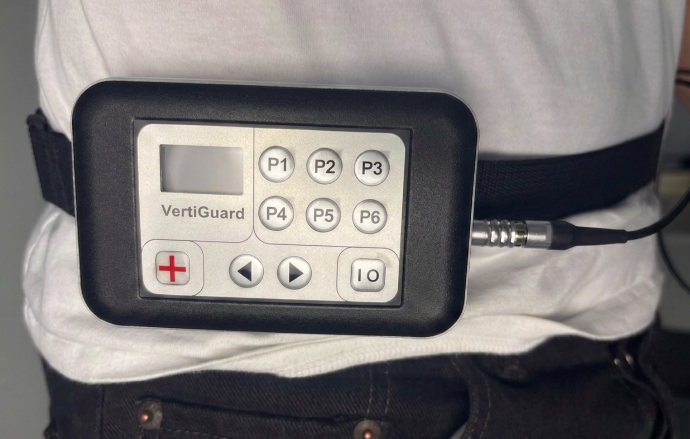
Mobile posturography
Classic posturography measures quiet standing on a platform. Falls, however, happen while walking, turning and bending. That is exactly where mobile measurement comes in.
The sensor sits at the body's centre of gravity and records sway during movements relevant to falls. The result is a clinical picture that matches your patient's everyday life and that you can explain to them.
Precise
Measurement at the centre of gravity instead of on the platform
Relevant to everyday life
Posture and balance during real movements
Referenced to norms
Comparison with age- and sex-related normative values
How a measurement works
No set-up, no calibration, no separate measuring room.
Put on the belt
The sensor is fixed at the body's centre of gravity. The patient stays in their normal clothes.
Movement tasks
Standardised everyday tasks, from steady standing to movements relevant to falls.
Evaluation
The sway values are automatically calculated against the normative data and presented as a report.
Why not the static platform?
Measurement during quiet standing
- Captures only one situation, in which falls rarely happen
- Tied to one place; the patient has to come to the platform
- Measuring point on the floor, not on the body
Measurement in motion
- Captures the movements in which falls really happen
- Mobile; the measurement takes place wherever there is space
- Sensor at the centre of gravity, where the sway occurs
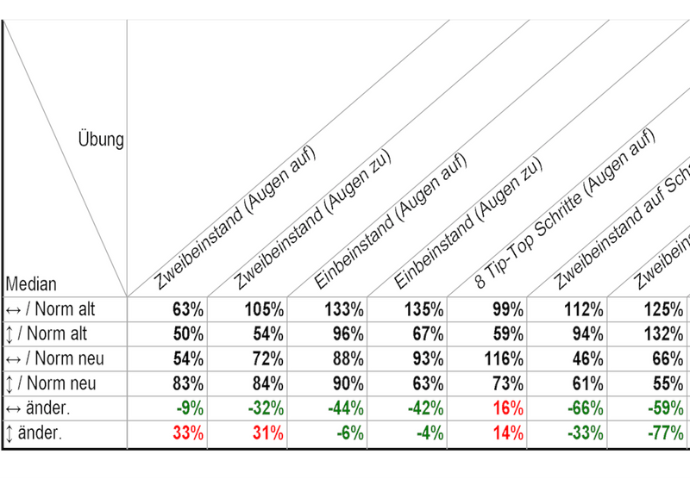
A report that supports a decision
- Sway values for each movement task, compared with the age norm
- Classification of the individual risk of falling
- An indication of which movements are conspicuous and where training should start
- A graphical presentation that you can show to the patient
Diagnosis first
A realistic assessment of the risk of falling, by measuring at the body's centre of gravity and during everyday movements in which falls occur.
Mobile posturography
Classic posturography measures quiet standing on a platform. Falls, however, happen while walking, turning and bending. That is exactly where mobile measurement comes in.
The sensor sits at the body's centre of gravity and records sway during movements relevant to falls. The result is a clinical picture that matches your patient's everyday life and that you can explain to them.
Precise
Measurement at the centre of gravity instead of on the platform
Relevant to everyday life
Posture and balance during real movements
Referenced to norms
Comparison with age- and sex-related normative values
How a measurement works
No set-up, no calibration, no separate measuring room.
Put on the belt
The sensor is fixed at the body's centre of gravity. The patient stays in their normal clothes.
Movement tasks
Standardised everyday tasks, from steady standing to movements relevant to falls.
Evaluation
The sway values are automatically calculated against the normative data and presented as a report.
Why not the static platform?
Measurement during quiet standing
- Captures only one situation, in which falls rarely happen
- Tied to one place; the patient has to come to the platform
- Measuring point on the floor, not on the body
Measurement in motion
- Captures the movements in which falls really happen
- Mobile; the measurement takes place wherever there is space
- Sensor at the centre of gravity, where the sway occurs
A report that supports a decision
- Sway values for each movement task, compared with the age norm
- Classification of the individual risk of falling
- An indication of which movements are conspicuous and where training should start
- A graphical presentation that you can show to the patient