Vestibular diagnostics at a glance · Otolith function
vOCR
Video ocular counter-roll · otolith function via head tilt
The vHIT tests the semicircular canals – until now there was no equally simple bedside test for the otoliths. The vOCR uses the video goggles to measure how far the eyes counter-roll when the head is tilted sideways. This shows the function of the utricle – without sound stimulus, without electrodes, in a few minutes.
Static head tilt 30°Utricular functionNo sound stimulus, no electrodesComplements the vHIT
How the test works All tests Technical information (PDF, German)
What the test measures
The otolith-ocular reflex of the utricle
When the head is tilted towards the shoulder, both eyes rotate about the visual axis in the opposite direction – the ocular counter-roll (OCR).
During the movement, semicircular canals and otoliths act together (torsional nystagmus). If the tilt is held, a static torsion remains that is generated mainly by the utricle – this is what the vOCR measures.
The video goggles detect torsion from the iris pattern and measure head tilt at the same time. Result: torsion in degrees and gain = torsion ÷ tilt. Healthy subjects counter-roll by about 4–5° at a 30° tilt (gain ≈ 0.15–0.2).
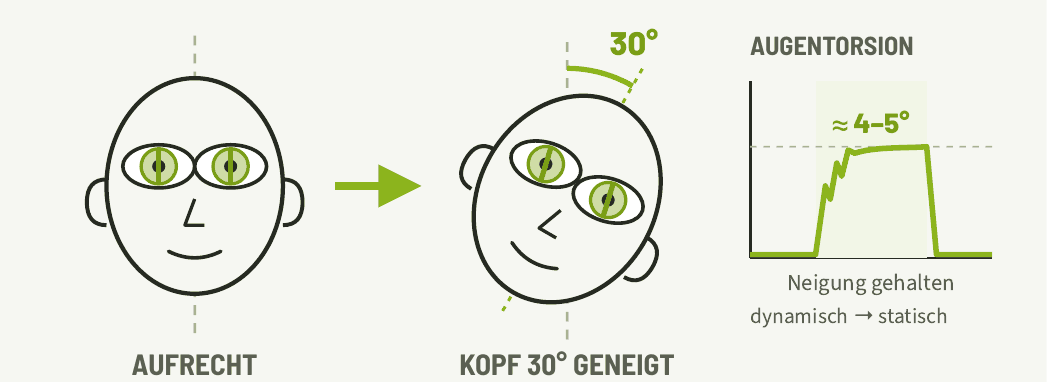
Schematic, torsion exaggerated. Graphic from the vOCR technical information.
How the test works
Approx. 7 minutes · patient seated · video goggles with torsion measurement
1
Prepare
The patient sits upright and fixates a target at eye level (approx. 1.3 m). Put the goggles on firmly and set the reference for iris and head position upright.
2
Baseline
Record 30 s upright with fixation. This gives the baseline torsion.
3
Tilt
Tilt the head passively 30° towards the shoulder – without nodding or turning. Check the angle with the goggles' position sensor.
4
Hold
Hold the tilt for 30 s while the patient keeps fixating. The static phase after the torsional nystagmus has subsided is evaluated.
5
Repeat
30 s back to the centre. 3 × right and left in random order; mean value per side.
Whole-body tilt variant: tilt head and trunk together by 30° (neck fixed, e.g. with a cervical collar). The contribution of neck proprioception is then removed – an otolith deficit shows more clearly. At the same time you can see how much the patient compensates via the neck.
Evidence · Johns Hopkins
vOCR at 30° head tilt
dashed: cut-off 3°
- Cut-off 3°: sensitivity 80%, specificity 81% – as accurate as VEMP
- Good reproducibility (variability ≈ 0.5°)
- Gain drops after loss and recovers: acute 0.08 → subacute 0.11 → chronic 0.13 (healthy 0.18)
Clinical benefit
When the vOCR helps
- Otolith screening at the bedside, in the same appointment as the vHIT
- Follow-up marker of compensation after vestibular neuritis or schwannoma surgery
- When VEMP cannot be recorded or is not available – the vOCR needs no sound stimulus
- Marked side asymmetry in the chronic stage may indicate a central lesion
Classification
vOCR in the test battery
| vHIT | vOCR | oVEMP | cVEMP | |
|---|---|---|---|---|
| Organ | Semicircular canals | Utricle | Utricle | Saccule |
| Stimulus | Head impulse | 30° tilt | Sound / vibration | Sound / vibration |
| Side | yes | loss only | yes | yes |
| Effort | Goggles | Goggles | Electrodes | Electrodes |
Limitations: In chronic unilateral loss both sides are similarly reduced – the affected side is determined by vHIT or VEMP. The vOCR does not assess the saccule – cVEMP remains the test for that. Normative values come from small cohorts.
Result
What you see in the result
- Torsion in degrees per side, upright and tilted
- Gain (torsion ÷ tilt) per side and side comparison
- Measurement mode: head only or whole-body tilt
- Course over several examinations, PDF report
Complements
vHIT
Tests the semicircular canals in the high-frequency range – together with the vOCR in the same appointment, a more complete picture of peripheral function.
Caloric test
Side-specific test of the lateral semicircular canal in the low-frequency range.
SHIMP
Second head impulse paradigm, helpful with residual function and for follow-up.
With Merlin
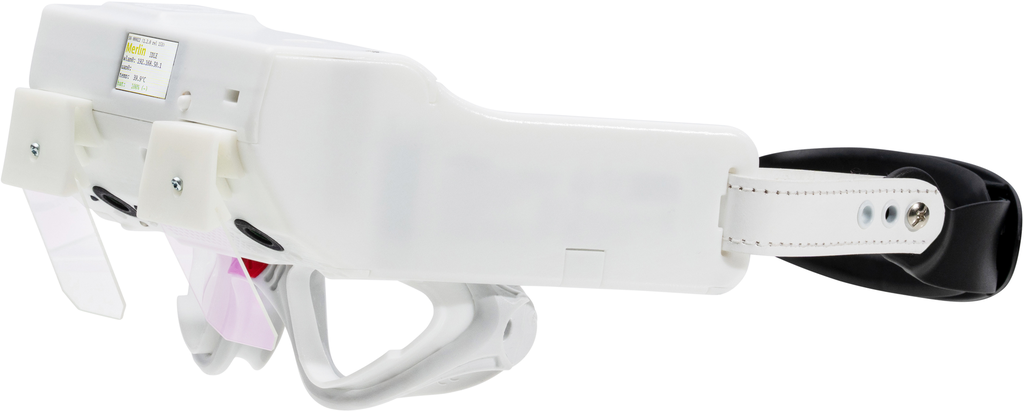
The vOCR is a software module for the Merlin video goggles. It uses torsion measurement from the iris pattern and the goggles' position sensor.
| Module | Merlin vOCR |
|---|---|
| Included in | Merlin Complete |
| Requires | Merlin video goggles with torsion measurement |
| Individually on demand (pay-per-use) | €23.80 per examinationAvailable – price on request |
Prices incl. 19% VAT (Germany). On demand: one examination per patient per day; requires a maintenance contract or a subscription on the system.
Frequently asked questions
No. The vOCR runs on the Merlin video goggles – without electrodes and without sound stimulus.
Both assess the utricle. oVEMP measures a muscle response to a sound or vibration stimulus and shows the side. The vOCR measures the eye movement during natural head tilt and mainly shows whether a loss is present.
Only to a limited extent: in the chronic stage both sides are often similarly reduced. The side is determined by vHIT or VEMP.
About 7 minutes, seated.
References
- Otero-Millan J, Treviño C, Winnick A, Zee DS, Carey JP, Kheradmand A. The video ocular counter-roll (vOCR): a clinical test to detect loss of otolith-ocular function. Acta Otolaryngol 2017;137(6):593–597.
- Yang Y, Tian J, Otero-Millan J, Schubert MC, Kheradmand A. Video ocular counter-roll (vOCR): otolith-ocular function and compensatory effect of the neck following vestibular loss. Otolaryngol Head Neck Surg 2023. doi:10.1002/ohn.304
- Otero-Millan J, Roberts DC, Lasker A, Zee DS, Kheradmand A. Knowing what the brain is seeing in three dimensions: a novel technique for measuring ocular torsion. J Vis 2015;15(14):11.
vOCR technical information (PDF, German)
Technical information for physicians. For billing questions, please contact your billing service.
See the vOCR live?
We will show you the test in a free online demo – with your questions.